
High-purity zinc acetate for industrial, pharmaceutical & specialty chemical applications
Manufactured under stringent quality controls, our Zinc Acetate ensures consistent purity, reliable performance, and precise composition across critical industrial and pharmaceutical applications.
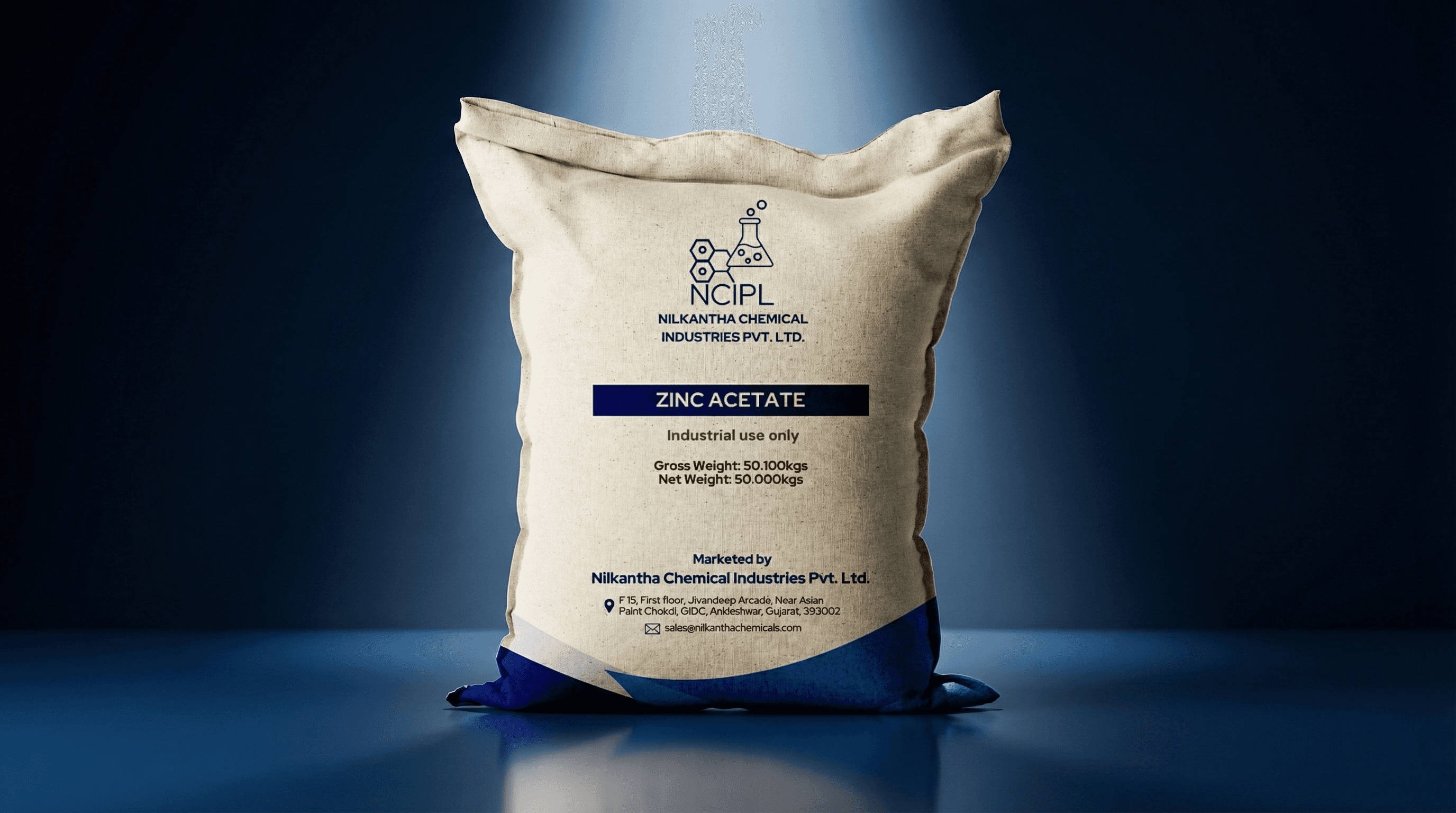
Product overview
Precision-manufactured for consistent results
Nilkantha Chemical Industries Pvt. Ltd. manufactures high-purity Zinc Acetate using refined production techniques and premium-grade raw materials. Our Zinc Acetate is available in both anhydrous and dihydrate forms, offering excellent stability, accurate composition, and extended shelf life.
Designed to meet demanding industry standards, our Zinc Acetate is widely trusted for chemical synthesis, dietary formulations, cosmetics, and specialty industrial applications.
We support bulk supply, customized grades, and export-ready packaging to meet diverse global requirements.
About sodium acetate
Zinc Acetate is obtained in both anhydrous form and as a dihydrate. Both are white crystalline solids. Zinc acetate is a salt with the formula Zn(O2CCH3) 2, which commonly occurs as the dihydrate Zn(O2CCH3)2H20)2. It is a zinc molecular entity and an acetate salt. Both the hydrate and the anhydrous forms are colourless solids that are commonly used in chemical synthesis and as dietary supplements. Zinc acetates are prepared by the action of acetic acid on zinc carbonate or zinc metal.
Industrial applications / Uses of sodium acetate
•
Industrial uses: Sodium acetate is used in the textile industry to neutralize sulphuric acid waste streams and also as a photoresist while using aniline dyes. It is also a pickling agent in chrome tanning and helps to impede vulcanization of chloroprene in synthetic rubber production. In processing cotton for disposable cotton pads, sodium acetate is used to eliminate the build-up of static electricity. Aniline dyes, derived from coal tar extracts, are often paired with sodium acetate during the textile dyeing process. Sodium acetate acts as a photoresist that stimulates patterned coating in photolithography and photoengraving.
•
Concrete longevity: Sodium Ethanoate or sodium acetate is used to mitigate water damage to concrete by acting as a concrete sealant, while also being environmentally benign and cheaper than the commonly used epoxy alternative for sealing concrete against water permeation. It seeps into the crevices on the surface of concrete, sealing it against the weather elements. Water damage is the bane of the construction industries in concrete treatment, and the capacity to seal concrete against water greatly saves time and money.
•
Food Industry: Sodium acetate may be added to food as a seasoning, sometimes in the form of sodium di acetate, a one-to-one complex of sodium acetate and acetic acid, given the E-number E262. It is often used to give potato chips a salt and vinegar flavour. It is used in food production, for lowering or stabilizing a product’s pH. Another positive trait of its acidity is the negative reaction of bacterial growth in the presence of sodium acetate. It is, therefore, a great preservative. For pickling, sodium acetate is mainly used to enhance flavours and preserve foods in large batch quantities.
•
Buffer solution: As the conjugate base of acetic acid, a solution of sodium acetate and acetic acid can act as a buffer to keep a relatively constant pH level. This is useful especially in biochemical applications where reactions are pH-dependent in a mildly acidic range (pH 4-6)
•
Pharmaceutic aid: Sodium acetate is used in dialysis solution.
•
Laboratory: Sodium acetate is used as catalysing in ethanol precipitation yield when isolating DNA and widely used as a reagent in molecular biology as well as biochemistry.
•
Medical: For patients undergoing dialysis, an intravenous transfusion of sodium acetate is recommended for electrolyte replenishment. It is given to Hyponatremic patients to stabilize falling sodium levels. sodium acetate is used for reusable heating pads and hand warmers as they rely on a supersaturated solution of sodium acetate and water surrounding a metal disc.
•
Cleaning: Impurities and Contaminants such as rust, stains, or scale on metal surfaces quickly vanish when with cleaning sodium acetate.